Creative Analytics for Performance Marketers (2026)
Rank what's working. Predict what's about to fail. Feed algorithmic auctions the variety they need to find winners. A field manual for creative testing at the scale 2026 demands.

TL;DR
In 2026, paid social platforms have eaten most of the bid and audience optimization. What's left for human marketers is creative — picking which assets to run, refreshing them before fatigue, and feeding the algorithm enough variety to find winners. Good creative analytics ranks ads on more than ROAS (CTR, hook retention, frequency, engagement quality), identifies winning visual and copy patterns across winners, and predicts fatigue 7–14 days before ROAS drops by watching CTR decay and frequency growth. Teams that run this loop weekly outperform teams that swap creatives "when ROAS drops" by a meaningful margin — typically 15–30% on annualized blended ROAS.
1. Why creative analytics matters more than ever
The 2017 performance marketer spent most of their day tuning bids, building audiences, and writing automation rules. Meta Advantage+, Google Performance Max, TikTok Smart Performance, and Snap Goal-Based Bidding have absorbed all of that. The remaining lever — the only meaningful one humans still pull — is the creative: the image, the video, the hook, the copy.
Three forces converged to make creative the lever:
- Algorithmic audiences won. Broad targeting plus good signals beats hand-tuned audiences in nearly every test since 2022. You can't out-target the algorithm. You can out-create it.
- iOS privacy collapsed audience precision. Even if hand-tuned audiences worked once, iOS 14.5+ broke the data they were tuned against. The creative now does the targeting — a video about your specific niche finds the audience that algorithms can no longer narrow to.
- Creative refresh cycles compressed. TikTok ads fatigue in days. Meta in weeks. Static ads in months. Teams that ship one creative per quarter are invisible to the algorithm by week two.
Creative analytics — measuring which creatives work, why they work, and when they'll stop working — is the discipline that closes the loop.
2. The metrics that actually tell you what's winning
Most teams rank creatives by ROAS alone. ROAS is a lagging indicator: by the time a creative's ROAS drops, it's already fatigued for 7–14 days. To catch winners early and losers earlier, rank on leading indicators alongside ROAS.
The four metrics that matter
- ROAS / CPA — the outcome metric, lagging by definition. The number you eventually optimize for.
- CTR (click-through rate) — leading indicator for relevance and hook strength. CTR decay (week 1 vs week 3) predicts ROAS decay.
- Hook retention (video only) — % of viewers still watching at 3 seconds, 15 seconds, etc. Strong hooks are the single biggest predictor of paid-social winners.
- Frequency growth rate — how fast frequency climbs on a fixed audience. Rapid frequency growth means the ad is being shown to the same people repeatedly — fatigue is near.
Combined, these four metrics let you triage creatives into four states:
| State | Signal | Action |
|---|---|---|
| Winning | ROAS above target, CTR stable, frequency under cap | Scale spend |
| Testing | ROAS unclear (low volume), CTR healthy | Hold spend, wait for volume |
| Fatiguing | ROAS still target but CTR dropping or frequency climbing | Plan replacement; refresh in 7-14 days |
| Losing | ROAS below target with declining or weak CTR | Pause now |
3. The creative fatigue curve — and how to catch it early
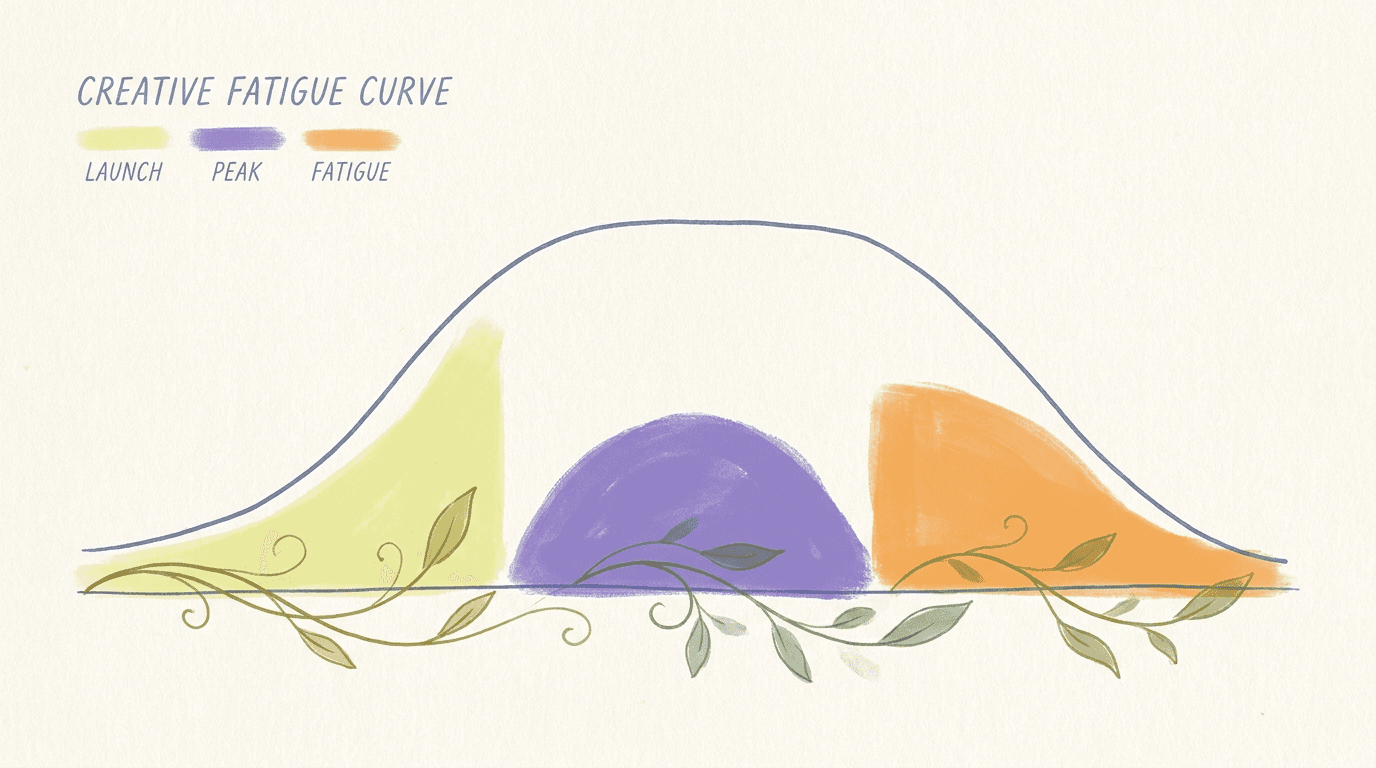
Every creative on paid social follows a predictable lifecycle:
- Launch (days 1-3). Algorithm explores; CTR is erratic; spend is conservative. Don't judge a creative in this window — give it a week before drawing conclusions.
- Discovery (days 4-7). Algorithm finds the best-responding pockets of the audience. CTR settles to a stable range. ROAS may exceed target.
- Peak (days 7-14). Spend scales, CTR holds, frequency grows but stays under your fatigue threshold. This is where the creative earns its budget.
- Decay (days 14+). Frequency climbs past 4-6 on fixed audiences. CTR starts dropping 5-15% week-over-week. ROAS holds for a week or two on lagged conversions, then drops.
- Dead (day 30+). ROAS below target. Pause and replace.
The early-warning triggers
Catching fatigue at the inflection (end of Peak / start of Decay) is worth 15–30% on annualized ROAS. The triggers:
- CTR decay > 15% week-over-week. The audience is starting to glaze over the creative. ROAS hasn't dropped yet, but it will within 7-14 days.
- Frequency > 5 on a fixed audience. You're showing the same ad to the same people 5+ times. Diminishing returns are imminent.
- Cost per outcome rising while spend holds flat. The algorithm is paying more for the same audience because they respond less.
- Hook retention dropping (video). % of viewers reaching 3s is declining week-over-week — the creative is losing the open.
Floowzy's AI Gardener watches all four of these signals across every creative in your account and surfaces fatigue 7-14 days before ROAS drops — so you swap with budget intact instead of scrambling to replace a dead winner.
4. Finding patterns across winners (not just individual winners)
Ranking individual creatives is useful for tactical decisions. Finding patterns across winners is what unlocks compounding gains — the next generation of creatives is built on the patterns you discovered in the last batch.
The dimensions to pattern-match on
- Hook style. Does the bold-claim opener outperform the question opener? The unboxing reveal vs. the before-after split-screen?
- Visual style. UGC vs. polished studio. Hand-held vs. tripod. Lifestyle vs. product-focused.
- Copy structure. Problem-agitation-solution. Three-feature listicle. Single benefit deep-dive.
- Length. 6 seconds, 15 seconds, 30 seconds, 60+. Each platform has its own sweet spot, and your audience may differ from the platform average.
- Format. Single image, carousel, video, GIF. Across creators or production styles.
Tag every creative with these dimensions when it ships. Six weeks later, query the winners by tag combinations — "all video winners with question-opener hooks under 15 seconds" — and you have a recipe for the next test batch.
Some platforms (Meta especially) now provide automated creative feature extraction inside their reporting. Treat platform-extracted features as a starting point; your own tagging is more nuanced and more useful for cross-platform pattern-finding.
5. Feeding the algorithm — variety as a strategic asset
Algorithmic ad platforms reward variety. Meta Advantage+ Shopping, TikTok Smart Performance, and Google Performance Max all explore the creatives you upload to find the combinations that resonate with the audience pockets you can't see anymore. The more variety you feed them, the more space they have to optimize.
The variety budget
A useful rule of thumb: maintain at least 10-15 active creatives per ad set on algorithmic campaigns, with at least 3-5 distinct creative concepts represented (not just variations of one). Below that, the algorithm has insufficient material to optimize against; above 20, it tends to consolidate spend on 2-3 winners and ignore the rest anyway.
The refresh cadence
For paid social on Meta and TikTok at meaningful spend ($30K+/mo):
- Weekly. Ship 2-4 net-new creative concepts per ad set.
- Bi-weekly. Pause fatigued creatives, scale winners, kill losers.
- Monthly. Pattern-match across the last 60 days of winners; brief the next test batch on what's working.
The cadence isn't optional. Teams that ship 1 creative per quarter are invisible to the algorithm by week 4. Teams that ship 1 per week stay relevant.
The collaborative-brainstorm layer
Creative is intrinsically collaborative — strategists, copywriters, designers, and creators all contribute. Floowzy's Garden Board is a real-time collaborative canvas where the team plants ideas, links them to the data (winners from last batch, fatiguing creatives, target audiences), and brainstorms with the AI Gardener proposing test variations based on what's working.
How Floowzy supports creative analytics
Every creative ranked on the four metrics that matter. AI fatigue prediction 7-14 days early. Pattern detection across winners. Collaborative brainstorming on the Garden Board. All read-only — Floowzy surfaces signals; your team makes the call. See pricing →
Frequently asked
›What is creative analytics?
Creative analytics is the practice of measuring the performance of individual ad creatives — images, videos, copy variations — and identifying which ones work, why they work, and when they'll stop working. It sits alongside campaign-level and audience-level analytics but focuses specifically on the assets themselves, which (in 2026, with algorithmic auctions absorbing audience and bid optimization) are the primary lever marketers still control.
›How do you measure creative fatigue?
Watch four metrics: CTR decay (week-over-week drop > 15% is a fatigue signal), frequency growth (over 5 on a fixed audience), cost-per-outcome rise while spend is flat, and (for video) hook retention drop. ROAS is a lagging indicator — by the time it drops, the creative has been fatiguing for 7-14 days. Catching the leading indicators 7-14 days early is worth 15-30% on annualized ROAS.
›How many creatives should I run per ad set?
On algorithmic campaigns (Meta Advantage+, TikTok Smart Performance, Google PMax), maintain at least 10-15 active creatives per ad set with 3-5 distinct concepts represented. Below 10, the algorithm has insufficient material to optimize. Above 20, it tends to consolidate on 2-3 winners and ignore the rest anyway — diminishing returns.
›How often should I refresh creative?
On Meta and TikTok at meaningful spend ($30K+/mo): ship 2-4 net-new creative concepts weekly, pause fatigued creatives bi-weekly, and pattern-match across winners monthly. Teams that ship 1 creative per quarter are invisible to the algorithm by week 4. Teams that ship 1 per week stay relevant.
›What's the most important creative metric — ROAS or CTR?
Both, in different time horizons. ROAS is the outcome metric you optimize for; CTR is the leading indicator that predicts ROAS. Rank creatives on both: high ROAS + holding CTR = scaling target. High ROAS + dropping CTR = fatiguing winner, plan replacement. Low ROAS + high CTR = audience-relevance issue, not creative issue. Low ROAS + low CTR = kill.
›How does AI help with creative analytics?
Three ways. First, AI ranks creatives across multiple dimensions simultaneously (ROAS, CTR, hook retention, frequency, fatigue probability) faster than spreadsheets allow. Second, AI predicts fatigue 7-14 days before ROAS drops by watching the leading indicators. Third, AI identifies patterns across winners — copy structures, visual styles, hook types — so the next batch of creatives is built on what's working, not on hunches.
›Should I let the algorithm pick winners or pick them myself?
Let the algorithm allocate spend within an ad set among the creatives you provide; you decide which creatives to provide. The combination — human curation of the test batch plus algorithmic spend allocation among the curated set — outperforms either alone. The pattern that fails is dumping 50 random creatives into one ad set and hoping the algorithm sorts it out. It will, badly.
Catch fatigue 14 days before ROAS drops.
Floowzy's AI Gardener watches the four metrics that matter across every creative in every connected ad account. Free tier, 60-second setup, no credit card.